The information contained in this article is not intended as legal advice and may no longer be accurate due to changes in the law. Consult NHMA's legal services or your municipal attorney.
Part One: State Aid to Municipalities Has Not Kept Up with Inflation
Although cities and towns have received increased distributions of the Meals & Rooms tax since 2021, state aid to municipalities, in total, has consistently failed to keep pace with inflation since the Great Recession. When adjusted for inflation, New Hampshire cities and towns are receiving less municipal aid today than they were in 2009, according to an updated analysis by the New Hampshire Municipal Association.
This information is important to know—and to share—as multiple bills this year seek to cap local spending through implementing or enabling statewide property tax caps or making it harder to pass a budget at the local level.
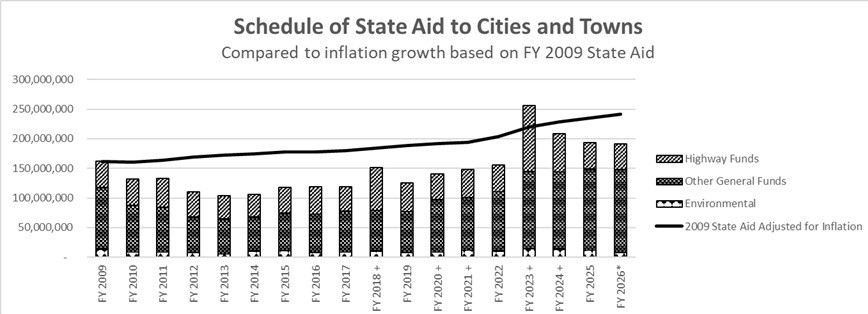
Sources: 2009 - 2015 from LBAO 09/21/16; 2016 - 2026 from LBA State of NH State Aid to Cities, Towns and School Districts FY Ending June 30, 2025 dated 10/1/2025; US Inflation Calculator.
* FY 26 based on budget amounts. All other years based on actual amounts.
Notes: The above chart deals with municipal aid only, not education aid. FY18 had a large supplemental Highway Block Grant. FY20 & FY21 had the extra Municipal Aid. FY 23 & FY24 had the extra retirement supplement to Fire & Police, as well as extra Highway and State Bridge Aid money.
Why does this matter to property taxpayers?
New Hampshire municipalities are limited in the options available to raise revenues for the support of city and town services, such as fire, police protection, road maintenance, waste management, planning and development and welfare assistance. Once the annual budgets are approved by the local legislative body (the town meeting, the town/city council, or board of aldermen), those budget appropriations are offset by local revenues—including state aid—with the balance raised by property taxes. This is called the “tax levy.” The more non-tax revenue the municipality receives, the lower the tax levy.
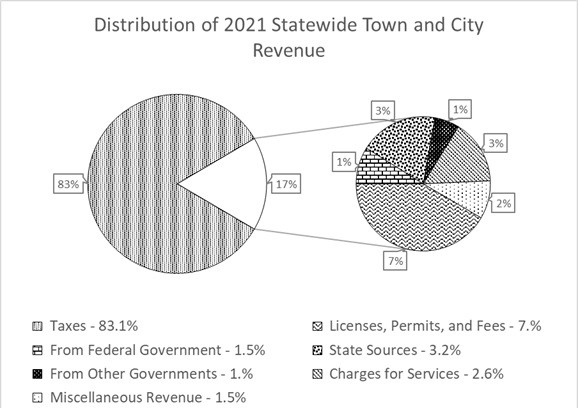
FY 2021 (most recent data available); Source: NHPFC
Like any large sum of money composed of different sources, municipal spending and aid can be sliced and diced multiple ways, highlighting parts of the pie, such as meals and rooms tax revenue, that have increased, while ignoring slices that have decreased, such as state aid grants for wastewater projects and the elimination of state funding for local retirement system contributions. However, focusing on the bottom line paints the truest picture.
More to come from NHMA on this topic.