Supporting effective municipal government through education, training, advocacy, and legal services since 1941.
The Impact of State Downshifting on Local Property Tax Burdens in New Hampshire (2015–2025)
The information contained in this article is not intended as legal advice and may no longer be accurate due to changes in the law. Consult NHMA's legal services or your municipal attorney.
The below is content from a memo, provided by Jack Wozmak on December 8, 2025, to the County and State Finance Commission on the impact of downshifting.
Jack Wozmak is the County Treasurer of Cheshire County. Any opinions expressed in this article are those of the author and not necessarily of NHMA.
Executive Summary
Over the past decade, the State of New Hampshire has reduced or eliminated multiple categories of state funding for local governments, effectively transferring an estimated $3 billion in costs to municipalities, school districts, and counties. These funding withdrawals have translated into significant increases in local tax burdens.
Without the $3 B state downshift, the total statewide property-tax levy today would be lower than it was 10 years ago. All growth in property-tax burden — and then some — is due to state shifts of costs. Local spending increases (municipal + school + county) were not large enough to explain the decade’s total levy growth by themselves.
The distribution of the downshift is estimated as follows:
- School Districts: ~$2.1 billion (≈70%)
- Municipal Governments: ~$600 million (≈20%)
- County Governments: ~$300 million (≈10%)
As school property taxes represent roughly two-thirds of the local tax bill, it is unsurprising that education downshifting dominates the ten-year total.
Background: New Hampshire’s Reliance on Local Taxation
When the state withdraws support from education, human services, infrastructure, or public safety, local governments must raise revenue—primarily through the property tax—to maintain essential services.
Defining Downshifting
For this report, downshifting refers to any state policy action that reduces state funding or increases local mandates, requiring local governments to increase property taxes to cover the difference. Examples include reductions in education aid, NHRS cost shifts, decreases in municipal aid, and Medicaid reimbursement shortfalls.
Breakdown of the $3 Billion Downshift
School District Downshift (~$2.1B): Driven by reduced state education aid, special education underfunding, charter tuition costs, and other mandates.
Municipal Downshift (~$600M): Includes the state's elimination of municipal retirement contributions, reductions in municipal aid and meals & rooms distributions, and shortfalls in highway and public safety funding.
County Downshift (~$300M): Largely a result of Medicaid nursing home reimbursement shortfalls and increased county obligations for human services.
Assuming the 60 / 25 / 8 / 7 % breakdown (school / municipal / SWEPT / county), here’s how a 2024 gross levy of $4.74B would map out roughly:
| Component | Share | Approximate Dollar Amount (2024) |
|---|---|---|
| Local school (town/city + school district) | 60% | ≈ $2.84 billion |
| Municipal (town / city operations) | 25% | ≈ $1.19 billion |
| SWEPT (state education portion) | 8% | ≈ $380 million |
| County | 7% | ≈ $330 million |
- Together, these sum to $4.74 billion (± rounding).
- Under this model, about $3.73 billion (≈ 79%) would be attributable to “local” decisions — municipal + local-school budgets — and the remaining $1.01 billion (≈ 21%) would come from components not strictly under local control (SWEPT + county).
Property Tax Impact
Over the past decade, total statewide property taxes increased an estimated $5.5–$7.5 billion. With a $3 billion downshift, roughly 40–55% of all property tax growth is attributable to state policy decisions rather than local spending increases.
If the state has downshifted $3 billion in costs over 10 years, and the total statewide property-tax burden grew by X dollars over those same 10 years, then:

NH’s total 10-year property-tax growth
- Current levy (2024): ≈ $4.74 B (our earlier estimate)
- Levy 10 years ago (2014): NH statewide levy around 2014 was approximately $3.4–$3.5 B (stable across many years and consistent with DRA/NHMA historical growth rates of ~3–4% annually).
To stay conservative, use $3.45 B for 2014.
So:
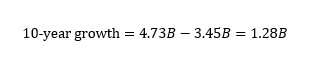
The statewide levy increased by approximately $1.28 billion over the past decade.
If the state downshifted $3 billion, and the total levy only rose $1.28 billion, then:
- The downshift amount is more than the entire measured levy increase.
- That means local spending decreases were offsetting an even larger hidden burden.
Percentage of tax-burden growth attributable to downshifting
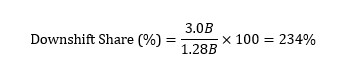
A percentage over 100% means:
- Without the $3 B state downshift,
the total statewide property-tax levy today would be lower than it was 10 years ago. - All growth in property-tax burden — and then some — is due to state shifts of costs.
- Local spending increases (municipal + school + county) were not large enough to explain the decade’s total levy growth by themselves.
In plain English:
State downshifting explains all of the property-tax increase over the past decade — and actually masked what would have been a decline in local property-tax burden.
Fiscal and Policy Consequences
Local governments face reduced flexibility, as more of their budgets are consumed by state-imposed obligations. Taxpayers pay more without receiving additional services, and disparities between property-poor and property-rich towns are exacerbated.