Supporting effective municipal government through education, training, advocacy, and legal services since 1941.
What affects property taxes in New Hampshire? Part 2
The information contained in this article is not intended as legal advice and may no longer be accurate due to changes in the law. Consult NHMA's legal services or your municipal attorney.
Part Two: Revenues and Appropriations
Municipalities continue to face a multitude of requests for services, the need to repair aging infrastructure, and requirements to meet more stringent federal and state mandates and regulations, all while combating the inflationary pressures the private sector also faces. Examples of these challenges include:
- Highway construction projects, according to the National Highway Construction Cost Index, have increased 68%-70% since 2021.
- The opioid crisis, as well as the peripheral issues associated with it, has stressed public safety services, often creating the need for additional personnel.
- Changes in federal and state environmental regulations have put a strain on local governments; PFAS monitoring and mitigation and the Lead Service Lines Inventory Project are just two examples.
- Since the onset of the COVID pandemic, labor costs have increased more than 25%, according to the Social Security Administration’s Average Wage Index.
- Not only were some municipalities participating in a health insurance risk pool asked to pay a one-time assessment in 2025, but most municipalities have seen an increase in their health insurance premiums up to 35% this year alone.
- Requests are constantly coming from residents and area businesses to spend funds on culture and recreation, economic development, conservation, etc.
Even with these and the many more issues municipalities face, cities and towns are asked to deal with them with little to no increase in property taxes. Compounding the outcry from some residents and legislators that local taxes are out of control, is the perception that when schools, precincts, or the county have property tax increases, it is the municipality’s fault as they are the entity who sends out the bill.
With these thoughts in mind, the New Hampshire Municipal Association has reviewed the changes in property taxes, estimated revenues, and appropriations since the Great Recession of 2008. We gathered data from the NH Department of Revenue Administration and used the NH Public Finance Consortium to fill in information back to 2009. The amounts shown below are the total statewide amounts.
As you can see from the graph, the growth in appropriations has, as expected, increased over the last decade and a half. When finding revenue to offset those appropriations, municipalities have begun to identify other funding sources, thus allowing their estimates to grow at a faster rate than the property taxes.
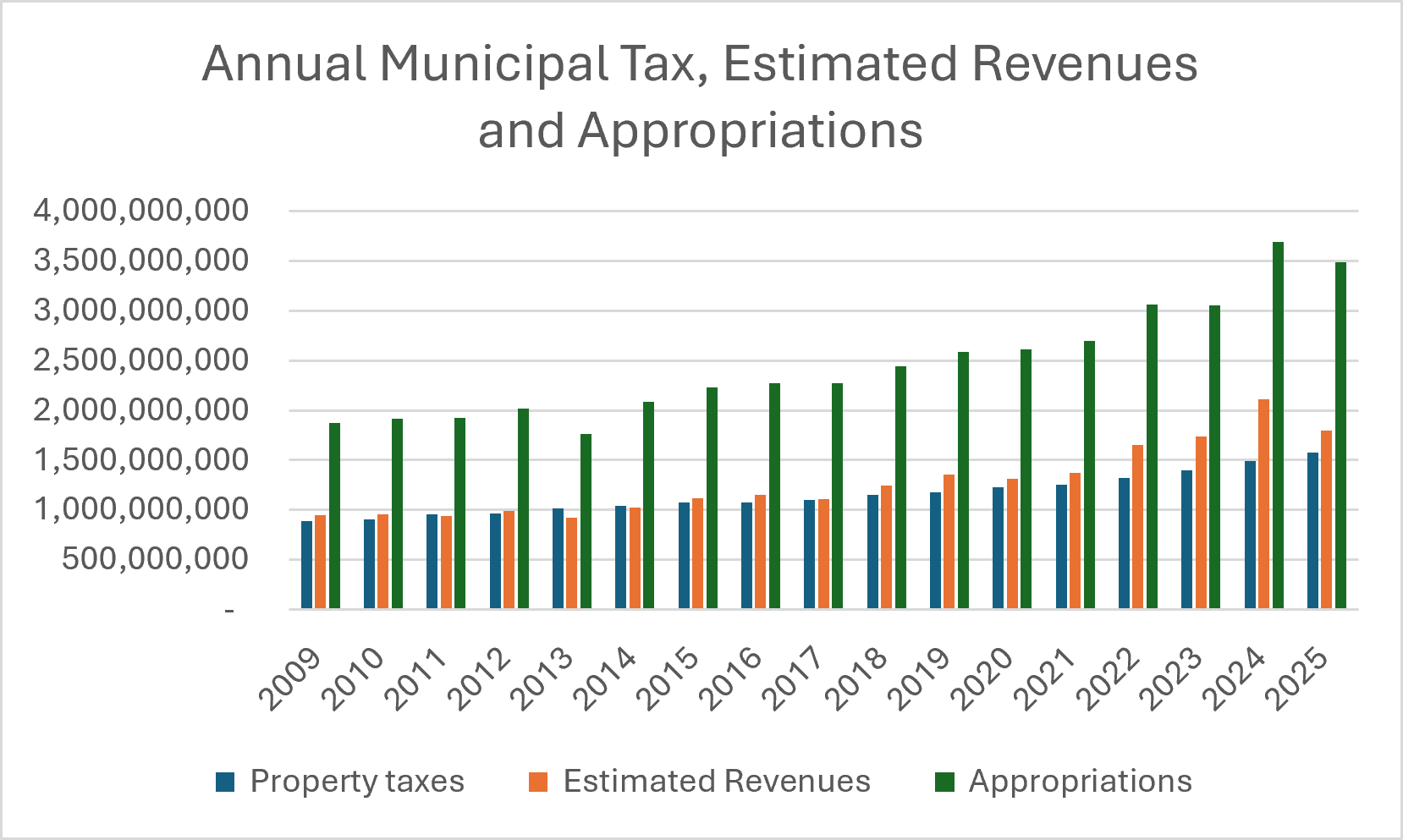
When digging deeper into the amounts that make up the above graph, NHMA found, based on the percentage change from 2025 as compared to 2009, the largest areas of increase were in other proprietary funds (such as development authorities and sports facilities like ice skating rinks), special revenue funds (such as highway funds and parking meter funds), capital reserve and expendable trust transfers, capital outlay and water distribution. Using the same parameters, special revolving funds, water revenue, proceeds from long-term notes and bonds, sewer revenue and miscellaneous revenue had the top increases in estimated revenue sources.
A significant percentage of the increase in appropriations in recent years has come from Post-COVID federal aid to states and cities, primarily from the $350 billion Coronavirus State and Local Fiscal Recovery Funds (SLFRF) under the American Rescue Plan Act. As of this year, most of this temporary emergency relief funding has wound down.
As a result, as the federal and state governments continue to push more services and mandates down onto the local governments, municipalities will need to continue to look for non-traditional revenue sources to offset those increasing appropriations. For example, while some of these ideas are not allowed under current state law, other states, counties and municipalities across the nation have begun to implement new revenue sources such as vacant property and “ghost hotel” taxes, tourism improvement districts, congestion pricing, tax increment financing, digital advertising taxes, single-use bag and container fees, and heavy truck / VMT fees. While not all these ideas may be right for our state, it might be time for New Hampshire and the local governments to look outside the box for additional revenue sources—in addition to continuing to advocate for more federal and state aid and grants, particularly for big-ticket infrastructure water, wastewater and road projects.
In the meantime, you can always try the “Adopt a Pothole” concept and ask local businesses and residents to pay to fix potholes in town.
* * *
If a member has found any viable, creative, legal ways of increasing revenues, let us know and we will share with the rest of our members.