Supporting effective municipal government through education, training, advocacy, and legal services since 1941.
NHARPC CORNER: Driving Toward Zero: New Hampshire’s Strategy for Safer Roads
The information contained in this article is not intended as legal advice and may no longer be accurate due to changes in the law. Consult NHMA's legal services or your municipal attorney.
Introduction
Transportation safety is a national challenge; 40,901 lives were lost in crashes in 2023. The United States has the poorest highway safety record compared to other developed countries. However, the Federal Highway Administration and states have a shared goal of zero deaths and serious injuries on public roads in the U.S. In New Hampshire and beyond, Regional Planning Commissions (RPCs) play an important role in reaching that aspirational but necessary goal.
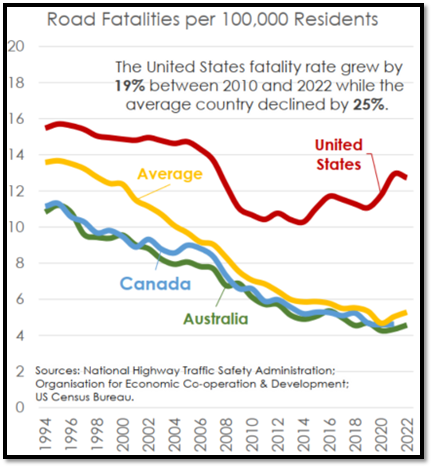
This article will discuss three programs that are utilized by RPCs and Departments of Transportation (DOTs) to ensure that our roadways are safe for all modes of transportation.
Highway Safety Improvement Plan/Strategic Highway Safety Program
The NH Highway Safety Improvement Program (HSIP) is intended to achieve a significant reduction in fatalities and serious injuries on all public roads. It aims to do this by implementing safety improvement projects based on data-driven approaches. New Hampshire’s FY 2026 apportionment under the Infrastructure Investment and Jobs Act (IIJA) is $13,264,464).
A key part of the HSIP is New Hampshire’s Strategic Highway Safety Plan (SHSP). The SHSP is a safety roadmap that explains where and why serious crashes occur and finds the best ways to prevent them; it is updated every five years, with an update currently underway in 2026.
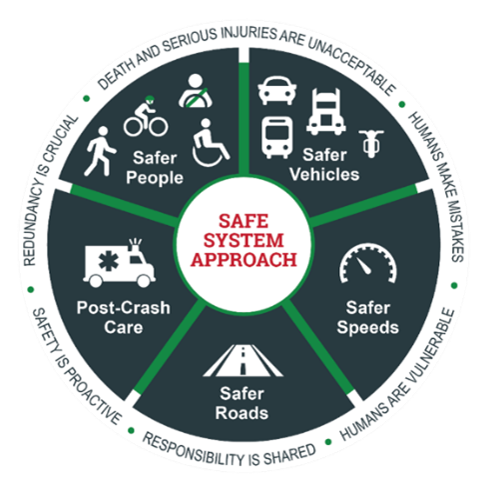
This SHSP update is guided by the Safe System Approach. Unlike other approaches, the Safe System Approach recognizes that people make mistakes. Instead of relying on any one solution or anticipating perfect behavior, it builds multiple layers of protection into the transportation system—through safer roads, speeds, vehicles, road users, and post-crash care.
New Hampshire’s SHSP will review the entire transportation system through the lens of the Safe System Approach. It will also
- Prioritize strategies that prevent severe crashes and reduce the chance of death or serious injury when crashes do occur
- Promote shared responsibility among roadway designers, policymakers, law enforcement, public health professionals, emergency responders, and road users
New Hampshire’s first SHSP was developed and adopted in 2008. Each update is a process that brings together many partners, including state and local agencies, law enforcement, emergency responders, regional planning commissions, public health organizations, safety advocates, and members of the traveling public.
For the 2027-2031 plan update, NH DOT will use many tools including crash data analysis and stakeholder workshops to identify priority issues and develop strategies. Working groups will convene through this summer, with regional safety summits planned for the fall and a draft final plan targeted for release in December 2026.
The resulting coordinated plan will be designed to save lives and reduce serious injuries on New Hampshire’s roads. For questions on this process, please contact Mark Munroe of the NH Department of Transportation (mark.t.munroe@dot.nh.gov).
Road Safety Audits
Road Safety Audits (RSAs) are one of the best ways for a municipality to respond to critical transportation safety issues. Wherever crashes have caused fatalities or serious injuries on any public road, a municipality can apply for a road safety audit through a simple application to NHDOT. 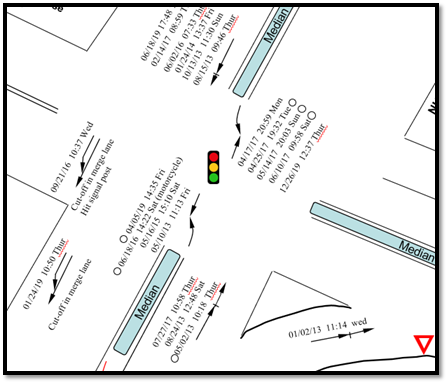 The NHDOT application requires a detailed diagram of crashes; the local police department is the best source for accurate records that are critical for a successful RSA application. The best way to start is by contacting your Regional Planning Commission. Full local crash reports have vital details about what might have caused crashes, from road and weather conditions to the behavior of drivers. RPC staff can help analyze crash information and generate a diagram in cooperation with local police.
The RSA process is rooted in engagement and comprehensive investigation of safety challenges by all stakeholders. It starts with a visit to the site of concern by staff from NHDOT, their engineering consultant, municipal staff, and other related stakeholders. The site visit is an opportunity to observe safety hazards first-hand and discuss potential improvements. NHDOT’s consultant team will then develop alternatives for safety improvements for short, medium, and long-term implementation. NHDOT and the municipality then prioritize which improvements to implement. There is usually some cost sharing; however, many improvements may be funded 100% with federal funds.
Examples of RSA’s and resulting improvements:
- A 2011 RSA led to a roundabout being built in Pelham in 2025 at the intersection of Sherburne Rd and NH128 (Google Map location).
- A 2019 RSA in Conway led to a roundabout being built in 2025 at the intersection of East Conway Rd and US 302 (Google Map location).
- Left-turn and center turn lanes were built along NH125 near the Rockingham Superior Court in 2025 after a 2023 RSA in Brentwood. Those improvements were constructed at the same time as planned road paving (Google Map location).
- An RSA was conducted in 2025 in Newmarket on NH108 south of downtown. NHDOT is currently working with town staff and leaders to select the best improvement and may use temporary materials to test improvements prior to permanent construction. (Google Map location)
Demonstration Projects to Implement RSA Recommendations
Demonstration projects are a novel approach to developing transportation infrastructure improvements. Also known as “quick-build” or “pop up” projects, many communities are using temporary materials such as paint, cones, and signs to test potential designs to ensure permanent improvements will be cost-effective. A demonstration approach can be highly effective for the RSA process – especially for pedestrian safety projects. NHDOT and Regional Planning Commissions are working with communities to implement demonstration projects.
Full flow chart of RSA process: https://www.dot.nh.gov/sites/g/files/ehbemt811/files/inline-documents/rsa-flowchart.pdf
RSA handout: https://www.dot.nh.gov/sites/g/files/ehbemt811/files/inline-documents/road-safety-audit-informational-handout.pdf
Safe Streets and Roads for All Program
The Safe Streets and Roads for All (SS4A) grant program, established as part of the Infrastructure Investment and Jobs Act (IIJA) in 2022, allocates $5 billion nationally in competitive grant funding over five years (2022-2026) to support regional, local, and tribal initiatives (not states) aimed at preventing serious injuries and fatalities from roadway crashes. There are two types of grants available: Planning and Demonstration grants, and Implementation grants.
Planning and Demonstration grants are utilized to develop Comprehensive Safety Action Plans (also known as Action Plans), conduct supplemental safety planning activities once an Action Plan is in place, or to undertake demonstration projects that test viability of safety approaches and projects prior to committing to permanent changes.
Implementation grants require that a community, region, or tribe have a Safety Action Plan (or similar) in place. The grants have a wide variety of eligible activities that include applying low-cost system-wide safety treatments, bicycle and pedestrian safety improvements, enhanced transit services, emergency response and trauma response system enhancements, education initiatives, and roadway improvement projects.
The City of Keene and the 72 communities contained within the Nashua, Rockingham, Southern NH, and Strafford Regional Planning Commissions are covered by approved Safety Action Plans and are eligible for Implementation Grants. Other communities may have transportation safety plans in place that meet requirements as well and the SS4A website includes a self-certification eligibility worksheet to assess this prior to applying for funds.
The Rockingham Planning Commission (RPC) was awarded a planning grant from the SS4A program in 2023 for four New Hampshire planning commissions (NRPC, RPC, SNHPC, and SRPC) to cooperatively develop regional Safety Action Plans. The four worked in collaboration with stakeholders such as transportation agencies, law enforcement, public health organizations, and community members and completed the process in early 2025 with each planning commission adopting a Safety Action Plan for their region and ensuring that each of the communities within their regions meet that basic requirement for pursuing SS4A Implementation Grants.
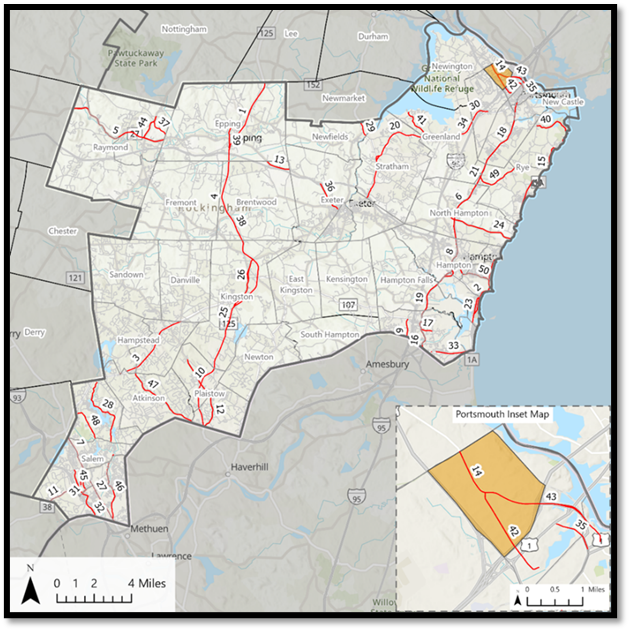
Safety Action Plans are comprehensive, data driven efforts that identify current traffic safety patterns and outcomes in a community or region and outline specific strategies and measures to enhance transportation safety, reduce crash frequency and severity, and ultimately eliminate serious injuries and fatalities. This process also relies heavily on inclusive public engagement where the concerns of a wide variety of stakeholders are heard and incorporated into the resulting recommendations and strategies.
They begin with a comprehensive analysis of crash data to identify high-risk locations, patterns, and behaviors, and risk factors leading to fatal and serious injury crashes. Local, regional, and state plans and policies are reviewed to understand the decision-making tools influencing roadway safety, and community input is gathered to incorporate the experiences and concerns of residents, workers, and travelers. The data analysis results and community input are summarized to establish a set of emphasis areas that reflect the region-specific safety issues and patterns observed.
Strategies are identified by linking these emphasis areas with the principles and elements of the Safe Systems Approach and FHWA’s Proven Safety Countermeasures resulting in a prioritized set of engineering, enforcement, education, and emergency response recommendations. Specific actions are identified for each strategy to create an implementation framework, and action items are prioritized for each of the emphasis areas and the High Injury Network which is a subset of roads where a high proportion of fatal, serious, and minor injury crashes occur. In the RPC region for example, the analysis indicates that 35% of the fatal, serious, and minor injury crashes occur on only 7% of the roadway network.
Implementing the Safety Action Plans involves continuing to collect crash data and monitor performance metrics, ongoing coordination with state and local partners, and seeking out funding opportunities for addressing identified local and regional priority actions. Funding sources available for implementing safety improvements include dedicated safety programs such as the federal SS4A program and NHDOT’s Highway Safety Improvement Program (HSIP). Other grant programs such as the Congestion Mitigation and Air Quality (CMAQ) and Transportation Alternatives Program (TAP) can be used for some types of safety projects.
In some cases, particularly for very low-cost improvements, utilizing local funding may be the fastest path to implementation. Additionally, the State Ten Year Plan is an option for longer-term improvement needs. Contact your Regional Planning Commission to discuss your project needs and they can aid you in determining funding options and limitations.
Improving transportation safety may seem difficult and complex. However, among the difficult changes facing our communities, there are copious ways to make significant safety improvements in the near term. Many transportation safety improvement actions have lower costs when compared with other municipal infrastructure projects. There are several resources and tools for identifying the best safety improvements for unique challenges in your community. The friendly folks at your Regional Planning Commissions are available to help.
Authors:
- David Walker – RPC Executive Director. dwalker@therpc.org; 603-658-0514
- Colin Lentz – SRPC Senior Transportation Planner. clentz@straffordrpcnh.gov; 603-994-3500 ext. 102.
- Adam Hlasny – SNHPC Senior Transportation Planner, ahlasny@snhpc.org; 603-669-4664.
- David Tilton – SNHPC Senior Transportation Planner, dtilton@snhpc.org; 603-669-4664.
Source Materials:
HSIP Section - NHDOT website
SS4A Section - Safe Streets and Roads for All (SS4A) Grant Program website, SS4A Clearinghouse website, FHWA Proven Safety Countermeasures, RPC Regional Safety Action Plan