Supporting effective municipal government through education, training, advocacy, and legal services since 1941.

The State Doth Protest Local Zoning Too Much
The information contained in this article is not intended as legal advice and may no longer be accurate due to changes in the law. Consult NHMA's legal services or your municipal attorney.
In 2025, we saw some of the most significant changes to the state’s zoning enabling laws in the last three decades. All the changes made to these laws prevent municipalities from adopting several different types of zoning ordinances, overriding existing voter-adopted ordinances that balance reasonable and responsible development with the rights of new and existing property owners. Additionally, these new mandates impede the key purposes of locally adopted zoning ordinances, including preventing overdevelopment that can overwhelm existing resources and infrastructure, harm others enjoyment of their property or public commons, and prevent large property tax burden shifts caused by unfettered development.
These new mandates were supported by housing advocates and members of the New Hampshire Housing Supply Coalition, such as the New Hampshire Home Builders and Housing Action New Hampshire, who blame local governments for the ongoing housing shortage.
Most of these bills received limited debate or discussion within the House Housing Committee, Senate Commerce Committee, and the Senate’s Subcommittee on Housing. For example, over 5 months of committee hearings, work sessions, and executive sessions, the House Housing Committee spent about 50 hours on 35 bills. We opposed nearly all these bills because they limited local decision making on zoning and land use. The House Housing
Committee voted 281-2 in favor of these bills, and placed all of them on the consent calendar, preventing debate or opposing viewpoints from being raised during the process.
When some of these bills were removed from the consent calendar and debated on the House floor, the majority tended to agree with our position, with us winning four of the six floor votes in the House. One vote we narrowly lost 179-170, and we would have won the vote if attendance were slightly different on that day; but “close” only counts in horseshoe and hand grenades.
The Senate did not see the value in local control over zoning this year. Leadership in both parties determined that they would treat land use law as a primarily “commercial” or “business issue” by sending every zoning bill to the Senate Commerce Committee. Zoning is not simply an economic issue; however, it appears the Senate will continue this approach for the time being. The committee referred many of these bills to the Senate Subcommittee on Housing,
chaired by the senator who introduced nearly all the antilocal zoning bills this year in the Senate.
The Senate did not roll call any of the anti-local zoning bills, except for Senate Bill 84 (the mandated minimum lot size bill). All the other zoning mandate bills passed on simple voice votes, with vocal opposition on many from the Senator of District 9. Even with a massive effort in the Senate to kill SB 84, led by us and our members, the bill eventually passed with the Senate President casting the deciding vote. This was despite the Senate postponing the vote on the bill two weeks in a row due to a lack of support and votes to pass the bill—but a floor amendment from the Senator of District 4, unfortunately, broke the gridlock. The House Housing Committee later retained SB 84 with the intent of reviving the effort next year, but only after a massive turnout by our
members and key state legislators at the committee hearing. This hearing served as a turning point as well, and we have seen the tides start to turn. We must continue to work hard and keep that momentum going.
Despite the adversity, our members were instrumental in helping get state representatives to act and vote against many of the worst bills. It took a while to get state legislators who agree with us to force floor debates and votes in the House. This was due to the legislative process and strategy of hiding these statewide zoning mandates on the consent calendar—a special docket of recommended action on bills that legislators “consent to” and rarely review. Once
the House woke up, they tended to act in support of local decision making and respected the votes on zoning ordinances made by Granite Staters in every town.
We must continue to raise awareness and encourage our state legislators to do the right thing by voting against future statewide zoning mandates or even repealing existing ones. The New Hampshire Municipal Association and our members must work to help more senators see the value in local decision making. Please call or email your senator to express your concerns about the bills that were passed and urge them to take a different approach next year: https://gc.nh.gov/senate/members/senate_roster.aspx.
The zoning mandates that passed were all signed into law by Governor Ayotte on July 15th. Again, thanks to our members, we embarked on a substantial veto request campaign, hoping the Governor would veto at least a few of the most harmful bills. Our requests and strong urging against these bills could not override the well funded campaign in favor of these mandates.
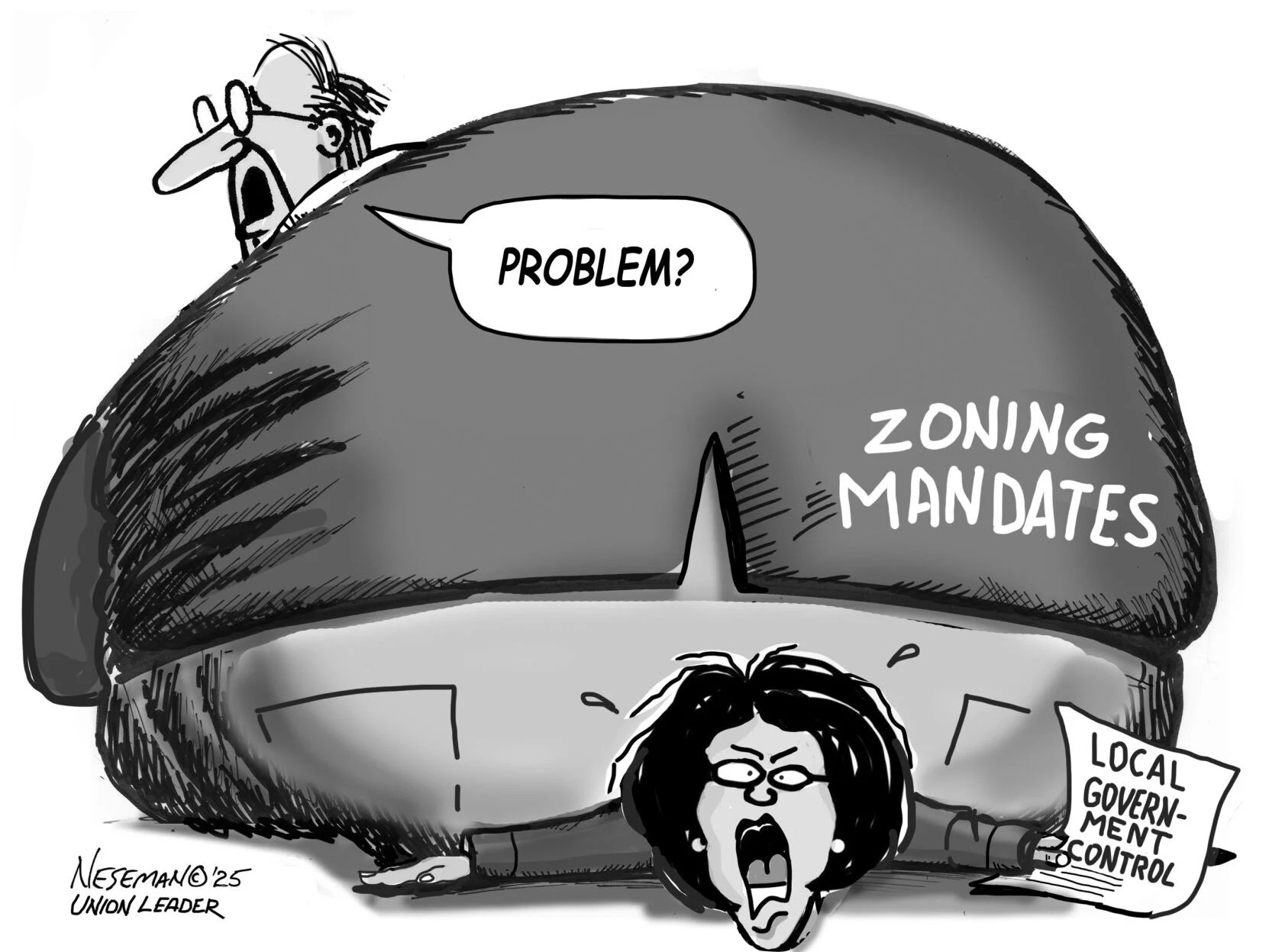
Here are the most notable statewide zoning mandates Governor Ayotte signed into law with no fanfare, no affordability requirements, or guarantee that this housing will be utilized by existing New Hampshire residents: Just state mandates.
HB 577, mandating that a municipality which adopts a zoning ordinance shall allow accessory dwelling units in all zoning districts that permit single-family dwellings. One accessory dwelling unit (ADU), which may be either attached or detached, shall be allowed as a matter of right, and municipalities may no longer require either a conditional use permit or special exception for an ADU.
Additionally, a plethora of local control provisions were removed from the existing state law. Municipalities may not adopt greater requirements for a septic system for a single-family home with an accessory dwelling unit than is required by the Department of Environmental Services. They can’t have local parking requirements for ADUs beyond what state law allows. They can’t require a familial relationship between the occupants of an accessory dwelling unit and the occupants of a principal dwelling unit or limit an ADU to only one bedroom. HB 577 also requires municipalities to allow accessory dwelling units to be converted from existing structures, including but not limited to detached garages, regardless of whether such structures violate current dimensional requirements for setbacks or lot coverage. (Effective July 1, 2025).
HB 631 requires municipalities to allow multi-family residential development on commercially zoned land, provided that adequate infrastructure for roads, water and sewerage systems is available to support that development. Municipalities may still restrict residential development in zones where industrial and manufacturing uses are permitted. Nevertheless, municipalities may require that the ground floor space in the commercially zone property may be required to be dedicated in whole or in part to retail or similar uses. (Effective July 1, 2026).
On top of these zoning mandates and others, the state established a commission to study the New Hampshire Zoning Enabling Act (what is now RSA 674:16-23). The commission created by HB 399 will be studying these provisions of state law and others to determine whether the state should eliminate sections of the enabling laws for local zoning. Specifically, the commission will “Determine if the listed powers are still appropriate and/or applicable today,
and if any could be removed or if any not present should be added,” amongst other charges to study. This implies further significant reforms to limit or end local control of zoning will be recommended.
We will be closely monitoring this study commission and asking our members with expertise and experience with local zoning to attend. We don’t want this study commission to become a trojan horse for more statewide zoning mandates.
The New Hampshire Municipal Association is committed to repealing these new zoning mandates, others that currently exist, or amending existing ones to make them less harmful or burdensome to municipalities and residents. We are engaging with key state legislators to get bills introduced, passed, and on the Governor’s desk. We will continue to keep our members informed throughout the process in the Legislative Bulletin. Municipalities are not the reason for the state’s housing shortage. The state’s years of limited to no action on funding or incentivizing housing access and infrastructure investments, coupled with decades of downshifting that put pressure on property taxes, plus economic factors outside our control, like interest rates and building and labor costs, are the most significant causes. I am reminded of a line from Hamlet that my father quotes from time-to-time: “The lady doth protest too much, methinks.” Methinks the state doth protest too much without taking real action to address housing. It’s time for the state to take ownership and stop scapegoating municipalities. In 2025, the state kicked down municipalities and then kicked the can down the road. We’re committed to a very different 2026.
In the meantime, please refer to our legal guidance on these bills and many others: https://www.nhmunicipal.org/new-laws-guidance.