Supporting effective municipal government through education, training, advocacy, and legal services since 1941.
NHARPC CORNER: Transit and Mobility Management Investment
The information contained in this article is not intended as legal advice and may no longer be accurate due to changes in the law. Consult NHMA's legal services or your municipal attorney.
Introduction
How would you get where you need to go in New Hampshire if you couldn’t drive? You may be like most Granite State residents and not have to worry
about this, but you probably have a neighbor or family member that can't drive or is nearing the age when they'll need to give up their keys. It's a frightening prospect for many, especially older residents, folks with disabilities, and people without means to own a car. Only 34 of 234 communities in the Granite
State have regular fixed route public transportation. Where they exist, public bus services play a key role in getting people to work, medical care and other
basic life needs; and helping employers access an adequate labor pool. Many other New Hampshire communities are served by nonprofit van services
and volunteer driver programs that focus on older adults and people with disabilities but not others in need. Still other towns lack transportation options
altogether if you don’t drive or don’t have family or friends nearby to provide rides.
This article provides a glimpse of ways in which transit systems, volunteer programs and other community transportation providers are working together to help expand transportation access across the state, and get New Hampshire residents where they need to go.
Mobility Management Concept
Since 2022 the NH Department of Transportation has funded a statewide network of mobility managers who work to improve the efficiency of existing community transportation services by expanding coordination and awareness of public and nonprofit transportation programs. Around the state this has included establishing a regional call center that books rides for multiple public and nonprofit transit providers; working with nonprofit volunteer driver programs to expand service to new towns, setting up new backstop transportation programs that offer rides when no other services are available; and developing new information tools to let people know what transportation services exist and facilitate taking transit or carpooling.
TripLink Regional Call Center
The Alliance for Community Transportation (ACT) is the Regional Coordination Council for 38 communities in Strafford, eastern Rockingham and southern Carroll Counties (RCC10). In 2013 ACT partnered with COAST, the Seacoast’s public transit system, to establish the TripLink call center. TripLink handles ride reservations and scheduling for COAST’s ADA paratransit and Route 7 On Demand services, as well as Portsmouth Senior Transportation, Meals on Wheels of Rockingham County, Community Action Program of Strafford County, and the Ready Rides volunteer driver program. An additional service known as Community Rides was established in 2015 to fill gaps when other agencies that schedule through TripLink don’t go to locations or at times that trips are needed.
In 2023 TripLink piloted a Common Application allowing people to call and sign up for rides from all the participating transportation services in the region for which they are eligible. With a single call to TripLink, people can access multiple services, saving them time and creating opportunities to combine trips, thus improving efficiency. Centralizing scheduling also reduces duplication of staff roles across the participating nonprofits. Since 2013 TripLink and its participating agencies have provided over 350,000 trips, and is currently adding an average of 61 new applicants per month through the common application.
Expanding Volunteer Driver Program Access in Rural Southern New Hampshire
Creating transportation alternatives in rural communities can seem challenging at times. But thanks to coordination among multiple agencies and stakeholders including two volunteer driver agencies (CVTC and Ready Rides) , three regional planning commissions (RPC, SNHPC, and SWRPC), three Regional Coordination Councils (RCC5, RCC8 and RCC10), several Mobility Managers, Cheshire County, and of course, community champions from Deerfield, New Boston, and Weare, the challenge was met in 2024 for three more communities that now have volunteer driver coverage.
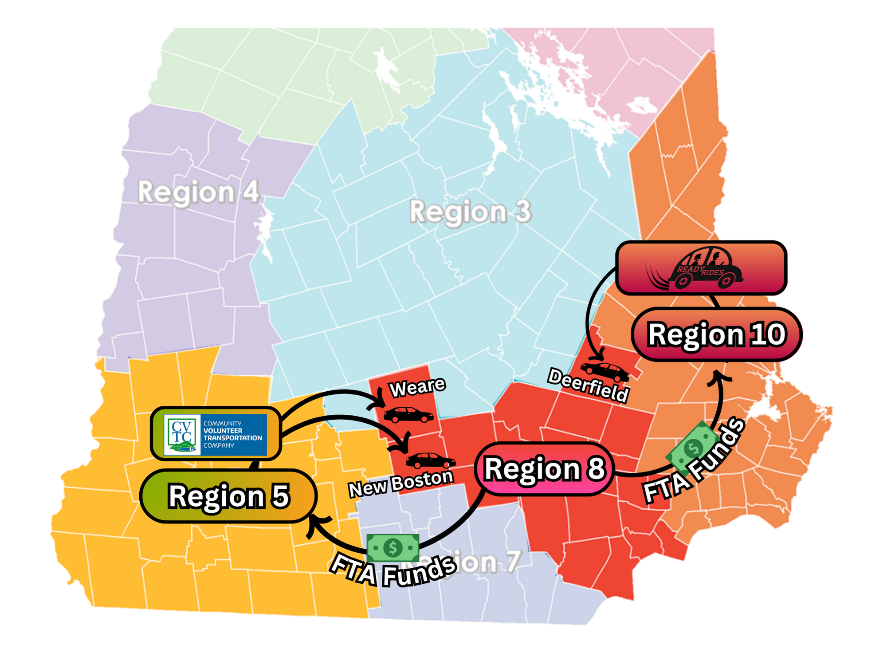
Starting in Deerfield, a group of ambitious citizens formed Age-Friendly Deerfield, whose mission is to implement services and practices which address the challenges of aging in Deerfield. The group was determined to bring transportation to their older residents, starting by building relationships with the regional coordinating councils and a volunteer driver program. The Region 8 RCC and ACT/Region 10 RCC facilitated a cross-regional agreement whereby Deerfield was picked up as a service community by Ready Rides and the TripLink call center described previously, with funding support through NHDOT.
Community champions organized through Age-Friendly Deerfield soon became volunteer drivers, and by neighbor helping neighbor, Deerfield became the first of three rural communities in the past year in the SNHPC region to begin offering a transportation alternative for their residents.
Much of New Hampshire’s coordinated transportation network is sustained by volunteer drivers willing to put in a few hours each month to help a neighbor.
Everyone is encouraged to volunteer on one of New Hampshire’s volunteer driver programs. Drivers are able to choose which rides they would like to do, based on their availability and area preference. Volunteers also receive staff-supported enrollment and orientation, calendar reminders via email, monthly mileage reimbursement, and loads of appreciation. Visit the NH Alliance for Healthy Aging’s website to learn more about what it is to become a volunteer driver: https://nhaha.info/volunteerdriver-initiative/.
Greater Nashua Community Rides Pilot Program
The Greater Nashua Region provides another example of agencies collaborating to improve transportation access. In 2024 the Nashua Regional Planning Commission (NRPC), the NRPC Foundation, and the Nashua Region Coordinating Council (RCC7), collaborated to establish a Community Rides Pilot Program to help fill gaps in existing community transportation services for elderly, disabled, or otherwise transit-dependent low-income residents of the
region. The program, coordinated by NRPC’s Regional Mobility Manager, leverages public and private dollars to fund taxi, Uber, Lyft, and other private transportation services, including wheelchair-assist services, for qualifying individuals to access medical appointments, trips to the grocery store and other needs where no other reasonable alternative exists.
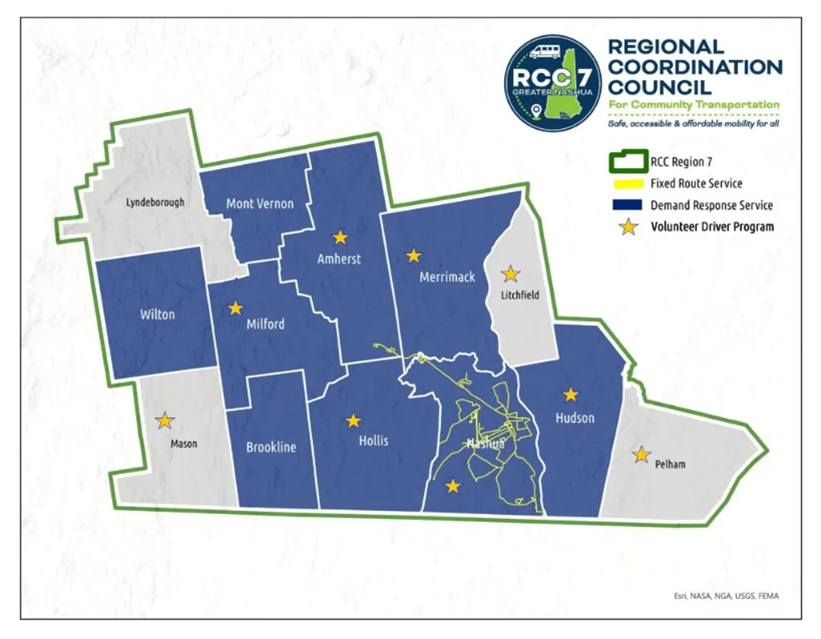
Most communities within the Nashua Region are served by some form of subsidized, demand-response community transportation services for elderly and disabled individuals, though there are significant gaps in service. Nashua Transit System (NTS) paratransit services are generally limited to destinations within the City of Nashua. The Souhegan Valley Transportation Collaborative (SVTC) only provides services within its six member communities as well as to and from Nashua, while NTS contracted services for Hudson and Merrimack provide rides between those communities and Nashua but not to any other communities. None of these services provide rides to key destinations outside the region such as to medical facilities in Boston or Manchester.
Further, none of these services operate on Sundays and only Nashua residents have Saturday or evening service. The Greater Nashua Community Rides Pilot Program is specifically designed to help fill those gaps in service.
The Community Rides program was initiated through a $2,500 grant made to the nonprofit NRPC Foundation from St. Mary’s Bank specifically for wheelchair-assist services. Since that time, additional private contributions have been received from multiple sources including individual donations. In 2025, RCC7 agreed to support the program for FY26-27 with $9,600 of Federal Transit Administration (FTA) Section 5310 dollars targeting older adults and people with disabilities. With the availability of 5310 funds, the NRPC Foundation’s privately raised contributions are only needed to cover the required 20% local match for an individual ride, allowing the Foundation’s limited resources to stretch further.
The NRPC, NRPC Foundation and RCC7 are striving to develop sustainable funding sources and operational efficiencies to ensure that the Community Rides program can continue to offer a viable transportation solution for some of the region’s most vulnerable residents into the future.
CommuteSMART NH & Connecting People to Existing Services
CommuteSmart New Hampshire (CSNH) is a statewide collaboration among the state’s regional planning commissions, state agencies, nonprofit transportationoriented programs, transit providers, and local businesses. CSNH’s primary, cooperative goal is to reduce the number of single-occupancy vehicles on the road in New Hampshire; by not only encouraging, but assisting people in their efforts to use sustainable transportation options and lessen congestion on the state’s roadways. It provides resources for those who need a ride, whether that’s because they are without an alternative option, or because they want to save money on commuting costs. CSNH connects commuters to existing networks by providing a free, personalized ridematching service. This service is complete with an interactive map of potential carpool partners, nearby park-and-ride lots, and available transit routes; alongside suggested bike
and walking options.
Supporting this mission, CommuteSmart New Hampshire introduced the NH Trip Planner on the Keep NH Moving website. This tool, powered by the AgileMile platform, allows users to plan multi-modal journeys for daily commutes, medical appointments, or weekend outings by seeking and presenting transit, bikeshare, carshare, and ride-match options in a single interface. AgileMile debuted its software in 2003 and has evolved into a cloud-based system with web, iOS, and Android apps. It underpins the Trip Planner’s sophisticated matching, trip-tracking, rewards features, and CSNH’s bi-annual smart commuting challenges. This ensures that New Hampshire commuters can seamlessly access and integrate greener travel options into their routines.
Sullivan County Transportation Commuter Bus between Claremont and Lebanon
While fixed-route bus services are most common in New Hampshire’s urban communities due to their population density, they can be effective in some rural corridors as well to help people get where they need to go. In Sullivan County, Sullivan County Transportation helps get people to their jobs, medical appointments, and connections to other modes of transit.
While earlier attempts at public transit around Claremont have faltered, in 2016 Southwest Community Services (SCS) stepped in and filled the gap. With encouragement from NHDOT, Sullivan County, community organizations and municipalities, SCS began a fixedroute bus service around Claremont with routes to employment centers in Newport and Charlestown, as well as a Dial-A-Ride service. At first, there was a sharp learning curve for SCS to run a transportation service – things like funding requirements, drug and alcohol screening, and fleet management. Since then, they’ve built a robust transit network and have added another route to Lebanon including a stop at Dartmouth Hitchcock Medical Center. These five routes connect residents to major shopping centers, medical centers, and employers. Additionally, they are the only public transit that stops at the Dartmouth Coach station in Lebanon, providing a
link to Boston and New York City for many people.
The demand was high in the region for transportation to employers, especially with many people in Claremont lacking the ability to get to any employers outside of the city. The bus is partially funded by a varied fare dependent upon the route, but it can be as low as $1.50 one way within the city/town up to $5 for a one-way ticket between Lebanon and Claremont. Commuters can purchase a month of unlimited Claremont-Lebanon rides for $50, making this an affordable option for many. Ridership has steadily grown from 30,000 riders in FY 2023 to over 38,000 riders in FY 2025. Sullivan Community Transportation has been connecting the disparate parts of Sullivan County and helping residents gain their full independence on the roads.
Investing State Dollars in Community Transportation
Coordination and mobility management are designed to make the most of the limited community transportation services that are available in the Granite State. Inflation has driven up the cost of operating public transit systems just like most other sectors of the economy in recent years. Volunteer drivers in private cars operate less expensively than bus systems, but still have costs for recruiting, training, coordination and mileage. Ultimately, ensuring our state’s
transportation network has the capacity to get people to work and help a rapidly aging population maintain independence will take new funding. For many years the State Legislature contributed a total of $200,000 annually statewide for public transit operating assistance. In the 2024-2025 state budget that amount was increased substantially to $2.28 million, in part to provide match for new Federal transit money coming to New Hampshire. This increased state
funding has supported service expansions in many parts of the state, including the Sullivan County service to Lebanon described earlier. Despite this, the Governor’s 2026-2027 budget eliminated the $2.28M in state contribution to transit operations entirely. Extensive outreach by riders, municipalities and chambers of commerce last winter resulted in the House Finance Committee holding a special work session focused on community transportation need
and ultimately putting this funding back in the budget. Even still, the roughly $1.00/capita in state funding New Hampshire allocates for public transportation represents about 1/50th of the national average state investment ($51.41/capita), and about 1/6 of the national median state investment ($6.29). Figures are from 2022, the most recent year for which consistent data are available. Our neighboring small rural states of Vermont and Maine, with similar populations, invest $6.32/capita and $20.24/capita respectively and are able to provide more robust transportation access to help their seniors and residents with disabilities maintain independence.
Conclusion
New Hampshire’s population age 75+ is projected to more than double between now and 2035. Our State Plan on Aging calls for supporting older adults to age in place at home, but that strategy only works if people can get out of their home to the doctor, to the grocery store, to the library or to a friend’s house for social contact. Similarly, as housing prices continue to rise in areas with high concentrations of jobs, employees are commuting longer and longer distances at greater expense, and employers face a challenge finding an adequate labor pool. Continuing to develop New Hampshire’s community transportation network is a key strategy for meeting the needs of an aging population, and at the other end of the age spectrum, getting people to jobs to keep our economy vital. Building capacity to truly meet these needs will require new investment by the Legislature, municipalities, and the private sector. In the meantime New Hampshire’s regional planning commissions, transit providers, mobility managers and many NHMA member communities are making investments now in coordination to get the most out of currently available resources. If you’re looking for different transportation options to get to work,
or looking for ride options for an aging parent or neighbor, visit www.keepnhmoving.com to learn about available services in your community.