Supporting effective municipal government through education, training, advocacy, and legal services since 1941.

Re-Imagined, Historic Fire Station Maximizes Firefighter Safety and Efficiency
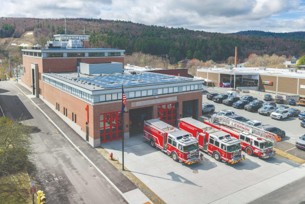
The grand opening of Lebanon’s new Central Fire Station was marked by a ceremonial uncoupling of linked fire hoses strung in place of the more familiar ribbon. Following suit, the design and construction of the $23.78 million facility was anything but traditional.
Having been constructed in 1954, the need to upgrade Central Fire Station was identified in 2022 when it was no longer meeting modern operational needs. Ahead of renovations, the City of Lebanon decided to maximize the buildings’ energy efficiency and leveraged support from Liberty, a NHSaves® utility partner, to take advantage of the best technical assistance and incentives.
Because the new Central Fire Station was set to occupy the same historic site as the original building , several challenges were encountered meeting energy goals:
- The site location and size were not sufficient to support a geo-thermal wellfield; as an emergency center, the fire station required building conditions to be maintained during periods of power loss and extremely low ambient temperatures. To preserve the required clearances to neighboring lot lines, much of the mechanical equipment in the building needed to be consolidated on the roof.
- The new facility’s state-of-the-art decontamination zone highlighted another area where achieving high efficiency presented a challenge. Exposure to toxic particles from modern chemicalized buildings is the main occupational hazard faced by firefighters. The new decontamination area ensures that all gear and personnel are safely moved from a dirty zone to a clean zone. Many specialized air source heat pumps and heat exchange recovery strategies were installed throughout the facility alongside 60 kW of solar panels on the roof space. The solar array supplies 58 percent of the building’s needs, including heating, and was grant funded with support from the city’s planning and energy departments.
- The grand opening of Lebanon’s new Central Fire Station was marked by a ceremonial uncoupling of linked fire hoses strung in place of the more familiar ribbon. Following suit, the design and construction of the $23.78 million facility was anything but traditional.
- Having been constructed in 1954, the need to upgrade Central Fire Station was identified in 2022 when it was no longer meeting modern operational needs. Ahead of renovations, the City of Lebanon decided to maximize the buildings’ energy efficiency and leveraged support from Liberty, a NHSaves® utility partner, to take advantage of the best technical assistance and incentives.
- Because the new Central Fire Station was set to occupy the same historic site as the original building , several challenges were encountered meeting energy goals:
- The site location and size were not sufficient to support a geo-thermal wellfield; as an emergency center, the fire station required building conditions to be maintained during periods of power loss and extremely low ambient temperatures. To preserve the required clearances to neighboring lot lines, much of the mechanical equipment in the building needed to be consolidated on the roof.
- The new facility’s state-of-the-art decontamination zone highlighted another area where achieving high efficiency presented a challenge. Exposure to toxic particles from modern chemicalized buildings is the main occupational hazard faced by firefighters. The new decontamination area ensures that all gear and personnel are safely moved from a dirty zone to a clean zone. Many specialized air source heat pumps and heat exchange recovery strategies were installed throughout the facility alongside 60 kW of solar panels on the roof space. The solar array supplies 58 percent of the building’s needs, including heating, and was grant funded with support from the city’s planning and energy departments
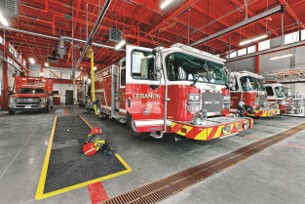
- Responding to emergencies requires opening the huge bay area of the station to immediate exposure to external climate at any time of day or night. To mitigate these frequent and serious temperature losses, the new design incorporated dedicated kitchen and vehicle exhaust systems and energy recovery from exhaust air streams to meet ventilation requirements. An air to water heat pump unit in combination with high efficiency, gas-fired boilers now provide hot water to the in-slab radiant floor for use throughout the whole building.
- Alongside these new upgrades, Central Fire Station is expected to receive over $50,000 in energy efficiency incentives from Liberty. These sophisticated energy-saving strategies were made possible by the financial and technical assistance of the NHSaves utility partners and are an example of its core mission: When the municipalities in our communities save, we all benefit from a healthier, more sustainable environment.
- Visit NHSaves.com to learn more about energy efficiency solutions for commercial, industrial and municipal customers and how your facility can make progress toward a sustainable energy transition.
- Responding to emergencies requires opening the huge bay area of the station to immediate exposure to external climate at any time of day or night. To mitigate these frequent and serious temperature losses, the new design incorporated dedicated kitchen and vehicle exhaust systems and energy recovery from exhaust air streams to meet ventilation requirements. An air to water heat pump unit in combination with high efficiency, gas-fired boilers now provide hot water to the in-slab radiant floor for use throughout the whole building.
Alongside these new upgrades, Central Fire Station is expected to receive over $50,000 in energy efficiency incentives from Liberty. These sophisticated energy-saving strategies were made possible by the financial and technical assistance of the NHSaves utility partners and are an example of its core mission: When the municipalities in our communities save, we all benefit from a healthier, more sustainable environment.
Visit NHSaves.com to learn more about energy efficiency solutions for commercial, industrial and municipal customers and how your facility can make progress toward a sustainable energy transition.