Supporting effective municipal government through education, training, advocacy, and legal services since 1941.

What affects property taxes in New Hampshire? Part Three: How New Hampshire Compares to Other States
The information contained in this article is not intended as legal advice and may no longer be accurate due to changes in the law. Consult NHMA's legal services or your municipal attorney.
There has been a steady stream of op-eds, articles, and speeches in recent years about how New Hampshire property taxes have gotten out of control. With this in mind, NHMA took a deeper dive into the question in a three-part series.
We first looked at state aid going back to 2009, the last year state revenue sharing under RSA 31-A was in effect for municipalities. The lookback found that although the dollar amount of state aid has risen, it had not held steady with inflation.
Next, NHMA looked at the statewide appropriations, estimated revenue, and property taxes over the same time period. In this review, the data showed that municipalities have increased their services—and therefore their appropriations—but were still able to keep the municipal portion of property taxes from increasing at the same rate, despite the decrease in inflation-adjusted state aid.
To wrap up this series, NHMA looked at property taxes as a whole in NH but also compared to other states. In 2025, New Hampshire raised approximately $5.1 billion dollars in property taxes, excluding the amount raised for precincts / village districts. Out of those funds, 7.1% was for state education taxes, 7.4% was for county taxes, 30.8% for municipal taxes, and 54.6% for local education taxes as shown below.
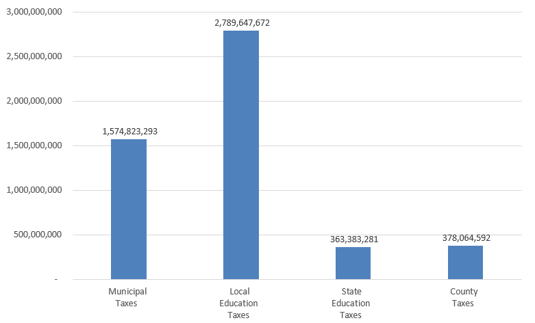
Compiled from data found in NH Department of Revenue Administration’s 2025 Municipal Tax Rates documentation
NHMA looked at the Lincoln Institute’s 50-State Property Tax Comparison Study to see how New Hampshire’s taxes compare to those in other states. Lincoln Institute, a nonpartisan source for research and data on urban planning, property taxation, and land use, compares many facets related to property taxes for the largest city in each state and the District of Columbia. While Manchester ranked 12th highest in tax rates and 10th highest in tax bills for median-valued residential homes, it ranked 38th highest in commercial property taxes, 41st in industrial taxes and 24th highest in taxes on apartment buildings.
The Tax Foundation, another independent, non-partisan research entity, compares all taxes across the 50 states, including property taxes. Although New Hampshire ranks 3rd best in their overall tax review, they rank New Hampshire as 44th in property taxes. The Tax Foundation points out that due to the lack of other taxes, New Hampshire relies heavily on property taxes.
When looking at education taxes, the largest portion of New Hampshire’s property taxes, the National Center for Education Statistics, an agency of the U.S. Department of Education, indicates that only 31% of revenue for public elementary and secondary schools is from state funding. Conversely, 61% of their funding sources are from property taxes. This ranks New Hampshire as tied for the second lowest in the nation in receiving public school revenue from state sources and the highest in the nation for revenue coming from local sources.
As municipal officials hear about escalating property taxes from state and regional officials, as well as your local taxpayers, you might want to fall back on basic accounting. To have a balanced budget, appropriations, whether from legislatively required or locally requested services, must have matching revenue. When a local government’s hands are tied in how it can raise money to offset these services, it must fall back on the only means allowed – property taxes. If these officials and taxpayers decide we need to cut back the amount of property taxes raised, they either need to allow additional funding sources or make the hard decisions to cut back services. It’s simple math.