Supporting effective municipal government through education, training, advocacy, and legal services since 1941.

NHARPC CORNER: "Local Solutions to New Hampshire’s Housing Challenge” How HOP Grants and Regional Planning Commissions Are Helping New Hampshire Municipalities Plan for Housing Needs
The information contained in this article is not intended as legal advice and may no longer be accurate due to changes in the law. Consult NHMA's legal services or your municipal attorney.
We’ve heard them all.
“Why are they only building ‘luxury’ apartments?”
“Young people don’t want to live in a rural state anyway.”
“We did our fair share. This is Manchester and Portsmouth’s problem.”
“The only place for my mom to walk is on her busy road. There’s no first-floor apartments she can afford.”
The federal and state governments have answered the call in their own ways, with the ROAD to Housing Act becoming law last month, and two sessions of the General Court discussing record numbers of bills related to zoning, parking, occupancy, and building codes. But local governments, who are privy to the day-to-day of welfare departments, developers, planning boards, property taxes, and other areas where symptoms of the housing crisis manifest still feel backed into a corner.
The regional housing needs assessments released in early 2023 produced the headline “90,000 homes needed” figure that has been seen statewide, and the state moved ahead with the InvestNH Housing Opportunity Planning grant (HOP) program. 73 communities jumped on this lever to complete partial and full updates of master plans, conduct zoning audits, and refine needs assessment figures. Many of these communities turned to their regional planning commission for help in a landmark collaboration of regional and local planning.
Wilton, a town of 3,800 under the Nashua Regional Planning Commission (NRPC), and Somersworth, a city of 11,800 under the Strafford Regional Planning Commission (SRPC), both utilized HOP grants to complete master plan chapters and successive zoning changes with help from their respective RPCs. Wilton sought to maintain its rural character and affirm a commitment to preserving land and natural resources. Somersworth leadership recognized the small city’s looming “full buildout” under GIS projections of its current zoning ordinance and understood that the ordinance created difficulties for builders looking to expand “missing middle” housing opportunities.
Community leaders in Wilton have worked diligently to balance this desire for rural character with the state’s need for more housing. Somersworth, meanwhile, has often been seen as a “bedroom community” of the employment hubs of the Portsmouth Naval Shipyard and other high-cost-of-living areas of the Seacoast region, while containing an underutilized mill town center. Wilton received two grants of funding through the HOP program, and Somersworth three. Both communities were able to utilize the outreach of these projects to greatly increase knowledge about planning and zoning processes, improve community engagement, and most importantly, amend and draft new regulations that expand housing opportunities while honoring development capabilities and conservation goals.
During its first round of funding, Wilton, with technical assistance from NRPC, established its own Advisory Board, consisting of Conservation, Planning, Select, and Zoning Board members, to help guide its HOP initiatives. The group fielded a survey that received around two-hundred responses, hosted an in-person community forum, and conducted two separate focus groups to gain insight into community members' perspectives on housing in Wilton. While the responses varied, the consensus was that residents support the idea of increasing the opportunity and availability of affordable housing but do not want to sacrifice the Town’s rural, New England character in the process. Ultimately, through a series of drafts, revisions, and public hearings, the NRPC helped the Town produce an updated Housing and Population chapter of its Master Plan, which helped to address these concerns. Notably, during the following zoning amendment season, the community passed regulations that decrease the minimum lot size requirements in the Residential District, reduce the age requirements in its age-restricted housing overlay, and overhaul its Accessory Dwelling Unit Ordinance. All of these items moved the Town closer to creating more housing opportunities, but there was still a lot of work left to do.
Somersworth’s Housing Master Plan chapter drafted by SRPC reiterated the urgency of the projected housing demand (colloquially known as “fair share”) in Somersworth from the Regional Housing Needs Assessment completed by SRPC the year prior. This Master Plan process was where a buildout analysis projected limited availability of developable land to accommodate these units. Like Wilton, the process included outreach facilitated by SRPC, with a survey and several discussions with Seacoast-area developers to identify gaps in communication in the building process in the City. City staff mobilized on a second HOP grant in the end stages of the Master Plan with the goal of completing a zoning audit.
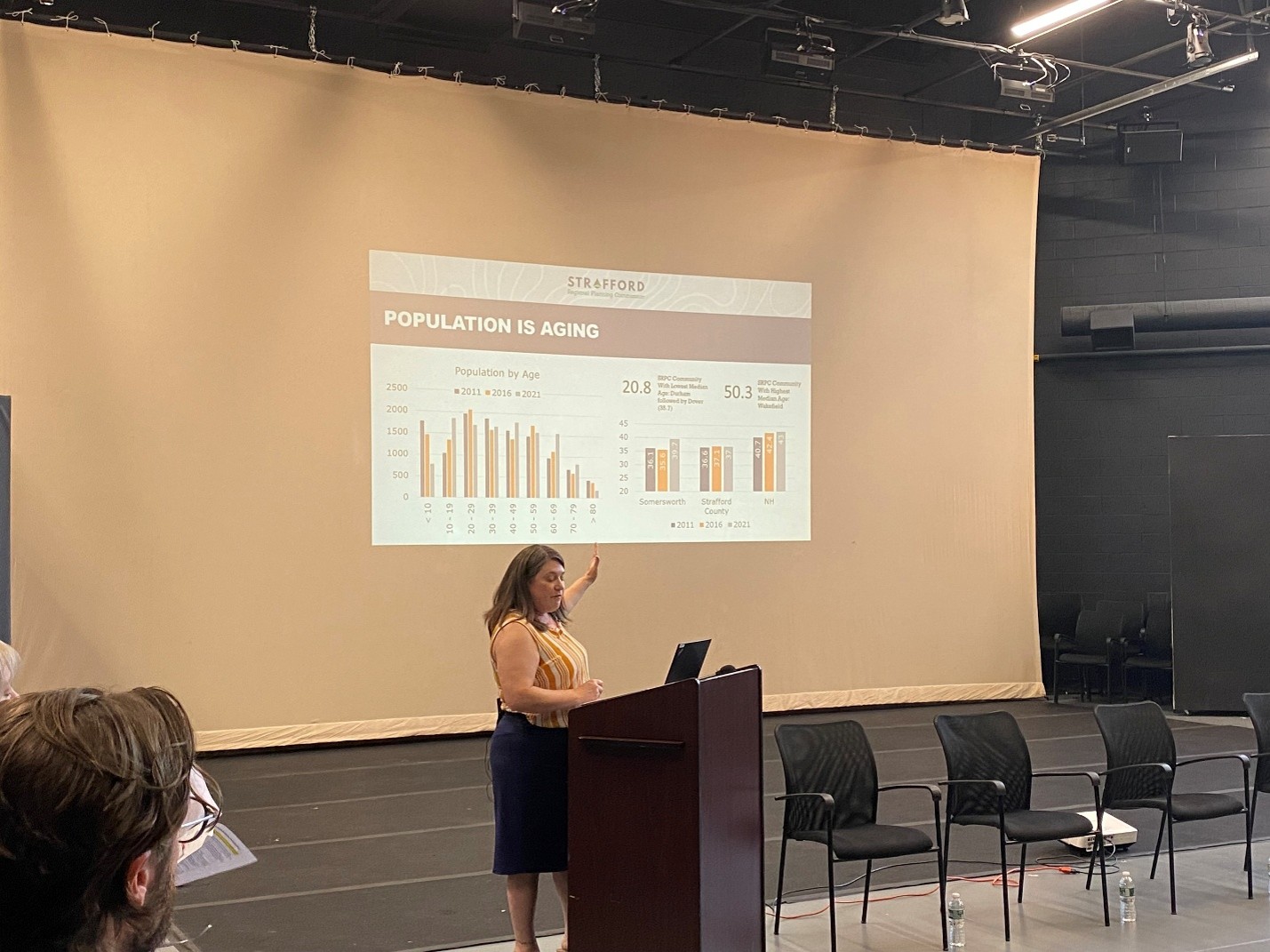
Below: SRPC Executive Director Jen Czysz presents Regional Housing Needs Assessment findings to the Somersworth community at a Master Plan workshop in September 2023.
In their second round of funding, Wilton drafted and adopted a Downtown Industrial Adaptive Reuse Overlay District. Residents within Wilton have continuously expressed a desire to revitalize their downtown area, which has a significant number of existing buildings and infrastructure that could be utilized to provide more housing, or economic opportunities. Their Downtown Industrial Adaptive Reuse Overlay District does exactly that, relaxing development requirements for buildings in the downtown core for both residential and commercial reuse.
Additionally, with the help of the NRPC, Wilton created an online engagement platform for their residents to follow and comment on the HOP process. The Planning Board has also begun amending their Cluster Development Regulations, to address residents’ overall desire to remain in a rural town, while increasing affordable housing. Through the HOP grant, the Planning Board has been able to fully explore cluster developments. Specifically, how this planning tool could help to implement more housing without drastically expanding the Town’s developed footprint. Currently, the Planning Board is looking to adopt both updated Vision and Land Use Chapters built directly from community feedback and oriented towards the Town’s long-term future.
In Somersworth’s second and third HOP projects, a zoning audit was completed in spring and summer 2024 and corresponding implementation of recommended zoning changes are being presented to the Planning Board in August 2026. SRPC used the newly-formed Mayor’s Housing Task Force as an advisory body for both efforts. An update to four additional Master Plan chapters was also being led by SRPC in 2025 and 2026, and joint outreach was conducted for these and the HOP zoning recodification efforts. Community members were invited to complete a survey and attend a community forum that sought input on housing typologies, neighborhood character, and development the City could incentivize for “blighted” areas. The Master Plan’s Historic & Cultural Resources chapter was one of these chapters, and SRPC facilitated a special focus group for the City’s Historic District Commission to obtain information on zoning that helps and hinders housing production in this area of the City.
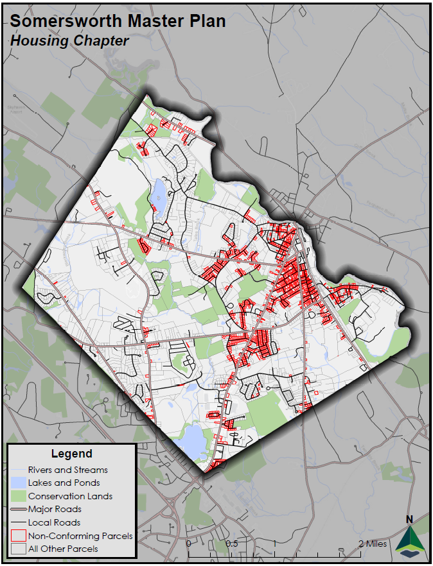
Below: Nonconformity analysis completed for parcels in Somersworth under the City’s 2023 zoning.
Communities in the Southern New Hampshire Planning Commission (SNHPC) region have also used HOP funding at different points in the local planning process. In Deerfield, the program supported an update to the Housing Chapter of the Town’s Master Plan, which was more than 12 years old. The project gave the Town a more current foundation for understanding its housing conditions and planning for future needs. Other SNHPC communities, including Candia, Londonderry, and Bedford, have used HOP funding to connect local data and community engagement with a closer examination of land use regulations.
Candia began its HOP work with a Housing Needs Assessment completed by SNHPC in 2024. A nine-member local steering committee guided the project, held eight public meetings, and helped distribute a town-wide housing survey that received 303 responses, representing approximately 7.6% of Candia’s population. SNHPC and the committee also spoke with approximately 80 residents during outreach events at the Candia Farmers Market. The results reflected a balance familiar to many rural communities. Residents expressed a strong desire to preserve Candia’s rural character while also raising concerns about rising housing costs, limited rental opportunities, and the ability of younger families and older residents to remain in town. Candia’s ongoing second phase builds on that work through an audit of the Town’s zoning, subdivision, and site plan regulations. The audit is intended to document how the current regulations function, identify areas where they intersect with state housing laws, and establish a foundation for future community discussions.
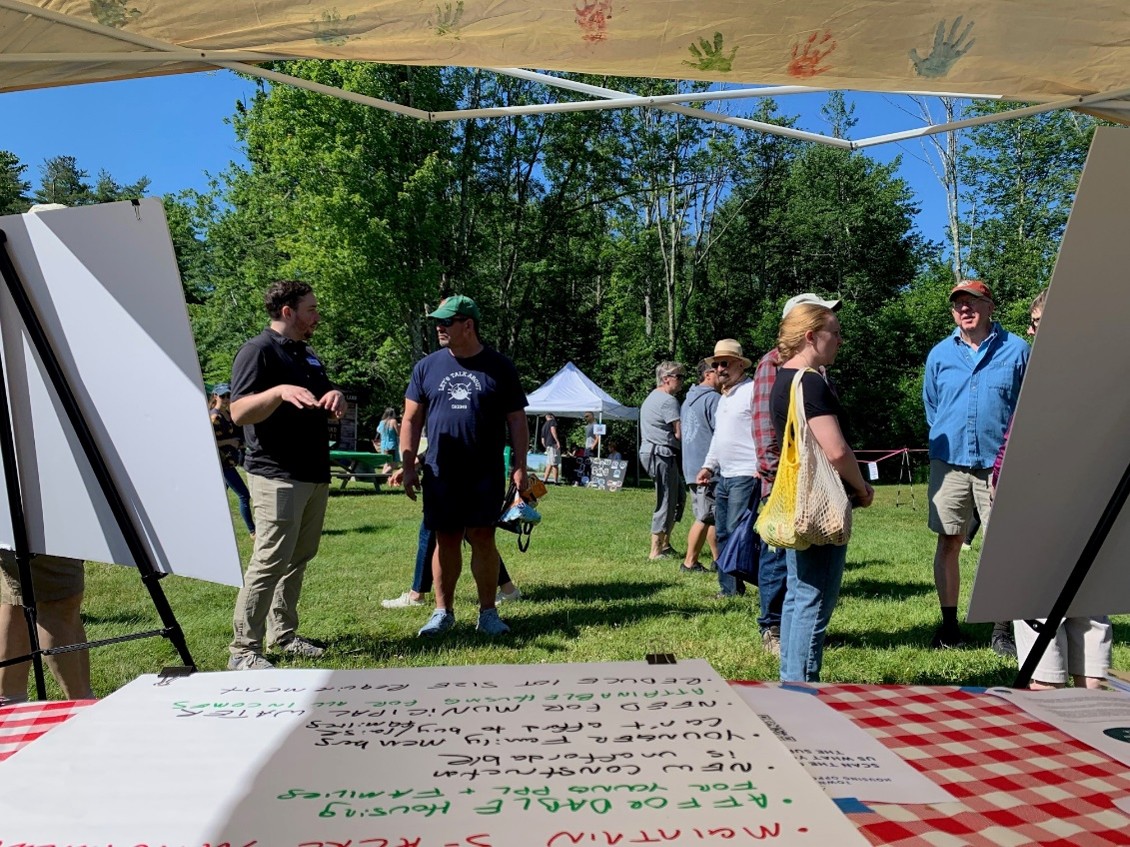
Below: SNHPC Senior Planner speaking with Candia residents about housing options at the Candia Farmer’s Market.
Londonderry’s HOP project is also ongoing. SNHPC is preparing a package of draft land use regulation concepts addressing accessory dwelling units, residential parking, the vesting of approvals, development on Class VI highways and private roads, and residential development in commercial districts. The work also explores locally tailored concepts for split-lot and cottage court development as potential smaller-scale homeownership options. Each concept is being evaluated in relation to the Town’s adopted Master Plan, existing development patterns, infrastructure, and community character. These materials remain working drafts and have not been advanced as formal Planning Board amendments. They are intended to provide the Town with a well-developed set of options that can undergo additional local, legal, and technical review before any decision is made about whether to pursue them.
Bedford’s experience illustrates how HOP-supported analysis can eventually move into local implementation. A multidisciplinary consultant team that included SNHPC conducted two public meetings, a community-wide resident survey, a meeting with Bedford’s land use boards and committees, and targeted outreach to developers, engineers, property managers, and employers. That work identified concerns about housing cost and availability, along with interest in housing choices that could better serve older residents, smaller households, and Bedford’s workforce. The resulting recommendations informed housing-related amendments presented to voters in March 2025. Voters adopted amendments updating Bedford’s workforce and senior housing regulations and creating a new pathway for cottage court housing, consisting of smaller single-family homes arranged around shared open space.
While the HOP program was likely never going to reduce rents and purchase prices right away, the effort equipped RPCs to move the needle on public opinion on housing supply. Few bodies in New Hampshire are able to recognize and reconcile the small distinctions of neighboring communities like Regional Planning Commissions. RPCs know when a town administrator is out on leave, the traffic volumes for a main intersection in a village center, and which grant to apply for to address cyanobacteria at a municipal lakefront. Wilton and Somersworth are just two communities that were empowered to be the voice for more housing, the planning process, and robust community engagement because of direct technical assistance from the HOP program. The work in Deerfield, Candia, Londonderry, and Bedford further demonstrates that this assistance can meet communities at different stages, from updating an aging master plan chapter and documenting local housing needs to evaluating regulatory options and bringing selected amendments to voters. Financial and staff capacity, not the lack of political will or community engagement, is often the binding constraint for communities of Wilton or even Somersworth’s size in the housing discussion. Without specific allocated funding for consultants and facilitation, master plan chapters, zoning ordinances, and overall community input are unable to be revised as frequently as they should be. All in all, the RPCs have sparked a wave of regulatory reform statewide and have inspired community members from all walks of life to sustain public discussion of housing that is accessible and attainable to all.
You can see Somersworth’s housing master plan, zoning audit, and upcoming zoning changes proposed by SRPC below.